
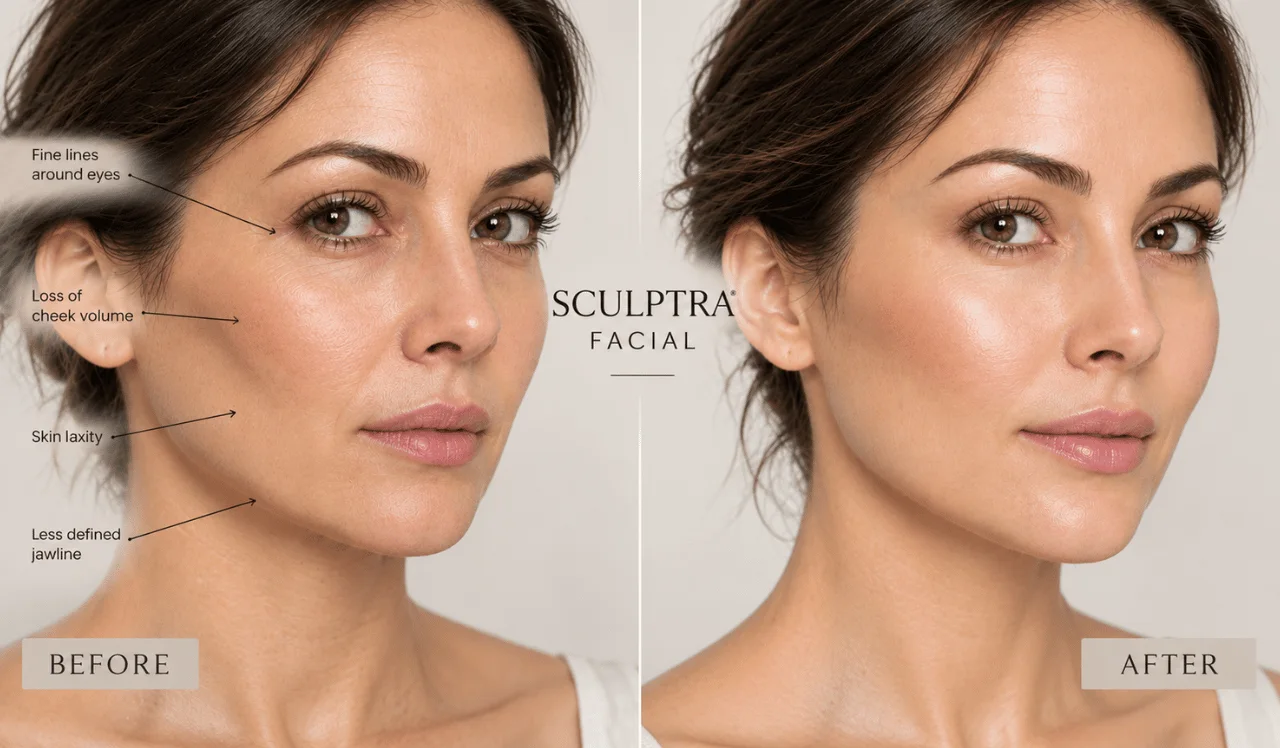

How Does Sculptra Work in the Skin?
When Sculptra is injected, the poly-L-lactic acid particles cause a mild response in the tissue. Your body treats this as something to respond to, and fibroblasts, the cells responsible for producing collagen, become more active in that area.
The Two-Phase Effect
There’s an initial phase right after injection, where some fullness comes from the product and the fluid it’s suspended in. That part fades within days. The second phase is the one that actually matters long-term: new collagen forming gradually in the treated tissue.
Why It Takes Time
Collagen doesn’t build overnight. Most patients need multiple sessions, spaced weeks apart, to see the fuller effect develop. This is normal and expected with Sculptra, not a sign that anything is going wrong.
What Can Sculptra Improve?
Sculptra is generally used for gradual volume loss and changes in skin quality, not sharp contouring. Depending on your goals, it may be considered for:
- Facial hollowing linked to natural aging, particularly in the cheeks and temples
- General thinning or loss of firmness in treated skin
- Overall improvement in skin structure and quality over time
It’s not the right tool for every concern. If you’re after an immediate, dramatic change in shape, Sculptra likely isn’t the best match, and your provider can explain why during your consultation.
There’s also a difference between what Sculptra can improve and what it can’t. It works well for gradual, broad changes in volume and skin quality, but it isn’t designed for sharp definition, like building a stronger jawline edge or adding precise structure to the lips. Concerns like those are usually better matched to a different type of treatment, and part of a good consultation is figuring out which category your specific goal falls into.
Sculptra for the Face:
The face is the most common area for Sculptra treatment. Cheeks and temples are frequently discussed areas, since gradual hollowing in these zones is a common part of facial aging.
Facial treatment with Sculptra is usually approached conservatively. Rather than trying to fully correct volume loss in one session, most plans build results across several visits, watching how your skin responds along the way.
This conservative approach exists for a good reason. Because the effect builds gradually, it’s easier to add more in a later session than to undo a result that went further than you wanted. Providers who take Sculptra seriously tend to start cautiously and adjust from there, rather than treating aggressively on the first visit.
Sculptra for the Neck:
Sculptra is sometimes discussed as an option for neck skin quality, though this use requires careful, individual evaluation. The neck has thinner skin and different anatomy than the face, so suitability depends heavily on your specific concern and assessment.
This page isn’t stating that Sculptra is routinely used for the neck at AgeEssence Medical Center. If this is something you’re interested in, raise it directly during your consultation so Dr. Mayagoitia can tell you honestly whether it’s appropriate for your situation.
What Happens During a Sculptra Appointment?
Treatment follows a fairly predictable sequence, though the details are shaped by your individual plan.
- Consultation. You talk through your concerns and goals.
- Assessment. Your skin and facial structure are evaluated in person.
- Treatment planning. A plan is built around your goals, including which areas to treat.
- Injection. Sculptra is administered to the planned areas.
- Aftercare instructions. You’re told how to care for the treated area, including guidance on massage if it’s part of your plan.
This page doesn’t go into specific injection technique or depth. Those details are clinical decisions made by your provider, not something to plan based on general information online.
How Many Sessions Will You Need?
There’s no universal number. It depends on your goals, the areas being treated, and how your skin responds.
Many patients need more than one session, often spaced a few weeks apart, since collagen builds gradually rather than all at once. Your provider can suggest a starting plan after your assessment, and that plan may shift depending on how you respond to earlier sessions.
It helps to think of each session as building on the last one, rather than as a separate, standalone treatment. Some patients see enough change after two or three sessions to stop there, while others continue with additional visits to reach their goal. There isn’t a fixed endpoint that applies to everyone, which is part of why ongoing communication with your provider matters throughout the process, not just at your first visit.
Sculptra Results: What to Expect Over Time
Results build in stages rather than showing up right after your appointment. In the first days, any fullness you notice is mostly from the injection fluid itself and fades quickly.
The more meaningful change, improved skin structure and volume from new collagen, tends to appear gradually over the following weeks and continues developing over the following months. How fast this happens, and how noticeable it is, varies from person to person based on your skin, your age, and how many sessions are part of your plan.
There’s no guaranteed week-by-week timeline that applies to everyone. If your provider gives you a rough sense of what to expect, treat it as a general guide, not a promise.
A common source of frustration is checking for results too early and assuming the treatment didn’t work. Because the visible change from collagen building is gradual, comparing photos from week one to week two often won’t show much difference. A more useful comparison is looking back every few weeks, or at the point your provider suggests reassessing, rather than day to day.
How Long Do Results Last?
Sculptra results aren’t permanent. How long they last depends on the areas treated, how many sessions you completed, your individual response, and your lifestyle.
Rather than quoting a fixed number of months, it’s more honest to say that results fade gradually, in the same way they built gradually. Your provider can talk through general patterns based on your specific treatment, but no clinic can promise you an exact duration in advance.
Some patients choose to have a follow-up session down the line to maintain their results once they notice the effect softening, while others are comfortable letting it fade naturally and reassessing later. Neither approach is more correct than the other. It comes down to your personal preference and what you and your provider discuss as your treatment plan evolves.
Benefits and Limitations of Sculptra
Being upfront about both sides of this treatment matters more than a sales pitch.
Potential Benefits:
Sculptra can offer a gradual, more natural-looking approach to addressing volume loss, since it works with your body’s own collagen response rather than adding a fixed amount of product. For patients who prefer subtle change over time instead of a sudden shift, this can be appealing.
Real Limitations:
Sculptra is not a fast fix. It requires patience, usually multiple appointments, and it won’t correct significant volume loss the way surgery or a larger filler treatment might. Results also aren’t guaranteed to look the same from patient to patient, since individual collagen response varies.
Possible Side Effects and Risks
As with any injectable, Sculptra carries some risk of temporary side effects. Common ones include swelling, redness, tenderness, and bruising at the injection sites.
Some patients also notice small bumps or areas of firmness under the skin after treatment, which are usually temporary but should be discussed with your provider if they persist. Sculptra isn’t risk-free, and no provider should tell you otherwise. Your specific risk factors are worth discussing openly during your consultation.
Rare but more serious complications, such as nodules that don’t resolve on their own, have been reported with biostimulator treatments generally. These are uncommon, but they’re part of why proper technique, appropriate product placement, and following your provider’s aftercare guidance, including massage if it’s recommended, all matter more with Sculptra than with some other injectables.
None of this is meant to discourage you from considering Sculptra. It’s meant to give you an accurate picture so you can make the decision with your eyes open, which is exactly the kind of conversation a proper consultation should include.
Recovery and Aftercare
Most patients return to normal activities fairly soon after treatment, though some temporary swelling or tenderness is common in the days that follow.
Massage is often part of Sculptra aftercare, since it can help distribute the product evenly in the treated area. How often and for how long you should massage the area depends on your specific treatment plan, so follow the instructions given to you directly rather than a generic routine you find online.
It’s reasonable to plan for some flexibility in your schedule right after treatment, since your skin may not look completely settled for a few days.
Who Is a Good Candidate for Sculptra?
Good candidates are generally patients dealing with gradual volume loss or changes in skin quality who understand that results take time to develop. Your overall health, skin condition, and expectations all factor into whether Sculptra is the right choice.
This is something an assessment needs to confirm, not something to self-diagnose from a symptom list online. During your consultation, be upfront about your goals, including how quickly you’re hoping to see change, since that alone can rule Sculptra in or out as the right fit.
Patients who tend to be satisfied with Sculptra are usually comfortable with the idea of a process rather than a single event. If you like the idea of watching gradual change unfold over a few months, and you’re not working around a tight deadline like a specific event, that mindset tends to match well with what this treatment actually delivers.
Who May Not Be Suitable?
Some patients aren’t good candidates for Sculptra, and a responsible consultation should catch this rather than proceeding regardless.
Relevant factors can include certain medical conditions, allergies, current medications, and previous reactions to injectable treatments. Share all of this honestly with Dr. Mayagoitia during your consultation so she can make an accurate recommendation. If Sculptra isn’t right for you, she can discuss what alternative might be.
Sculptra vs Hyaluronic Acid Fillers:
These two categories work differently, and neither is automatically better.
Hyaluronic acid fillers add volume immediately and are often used for precise contouring, like defining the lips or cheekbones. The results are more predictable in the short term, but the fillers themselves are eventually absorbed by the body.
Sculptra takes longer to show results because it works by stimulating your own collagen rather than adding volume directly. It’s generally better suited to broader, gradual improvement rather than sharp, immediate shaping.
Which one fits your goals depends on what you’re trying to achieve and how quickly you want to see it.
Sculptra vs Other Collagen Biostimulators
Sculptra isn’t the only biostimulator on the market, and other products, such as Radiesse, work through a somewhat different combination of mechanisms.
Radiesse tends to offer more immediate volumizing effect alongside some collagen stimulation, sitting between traditional fillers and Sculptra in terms of how quickly you’ll notice change. Sculptra leans more heavily on the gradual collagen-building side.
Neither is universally “better.” The right choice depends on your goals, your treatment area, and your provider’s clinical judgment after assessing you directly.
Choosing an Experienced Provider
Because Sculptra involves technique-dependent placement and a treatment plan that unfolds over multiple visits, the provider’s experience and judgment matter.
A responsible provider will take time to understand your goals, explain realistic timelines honestly, and tell you if Sculptra isn’t the right fit rather than defaulting to it. They should also walk you through the possible side effects and recovery clearly before you commit to treatment.
It’s also worth asking how a provider approaches dosing and pacing across sessions. Because Sculptra’s effect is cumulative, an overly aggressive early approach is harder to correct than a conservative one that’s built up gradually. A provider who’s willing to explain their reasoning, rather than just quoting a package price, is generally giving you a better indication of how carefully they’ll plan your treatment.
Sculptra Pricing at AgeEssence Medical Center
Current pricing at AgeEssence Medical Center is structured as follows:
- Sculptra, 1 ml: $15,000
- 3 sessions: $30,000
The right treatment plan, including how many sessions and vials you’ll need, depends on your goals and what your provider recommends after assessing you. Final pricing should be confirmed directly with the clinic during your consultation.
Sculptra in Playa del Carmen for Visitors
AgeEssence Medical Center sees both local patients and visitors to Playa del Carmen. If you’re considering Sculptra during a trip, contact the clinic before you arrive to schedule a consultation and talk through timing.
Since Sculptra usually involves more than one session over several weeks, a short trip may not be long enough to complete your full treatment plan or see final results before you leave. Some visitors plan their sessions around future trips back to the area, but this needs to be worked out directly with your provider rather than assumed in advance.
If your trip is short and Sculptra’s gradual timeline doesn’t fit your schedule, it’s worth saying so during your consultation. Dr. Mayagoitia can talk through whether a different treatment approach, or simply starting your Sculptra plan now and continuing it on a future visit, makes more sense given your travel plans.
Ready to Discuss Sculptra?
If you’re weighing whether Sculptra is right for you, the best next step is a real conversation, not more searching online. Dr. Belinda Mayagoitia can assess your skin, talk through your goals, and give you an honest answer about whether Sculptra fits what you’re looking for.
Request a Free Consultation. Call 984 138 5578.