

How the Two Components Work Together?
Think of HArmonyCa as doing two jobs at once, on two different timelines.
Right away: The hyaluronic acid adds volume as soon as it’s injected. This is the part you’ll notice at your appointment.
Over time: The calcium hydroxyapatite stimulates collagen production in the treated tissue. This part builds gradually and continues developing after your visit.
Because of this, your appearance right after treatment isn’t necessarily your final result. Some of what you’re seeing early on is temporary swelling combined with the immediate HA effect. The fuller picture takes shape over the following weeks as your body responds to the CaHA component.
What HArmonyCa Can Help With?
HArmonyCa is generally considered for patients dealing with facial volume loss who also want some degree of longer-term tissue support, not just a temporary fill.
Common goals include:
- Restoring volume lost through natural aging, particularly in the cheeks
- Improving overall facial contour where structure has softened
- Addressing concerns that benefit from both an immediate and a gradual improvement
It’s not built for every situation. If you’re after very precise, sharp contouring, a dedicated HA filler designed for that purpose might be a better match. If you want a purely gradual approach with no immediate change at all, a pure biostimulator like Sculptra might suit you better. HArmonyCa sits in the middle, and whether that middle ground fits your goals is something worth discussing directly.
Not sure which category your goals fall into? That’s exactly what a consultation with Dr. Mayagoitia is for.
It also helps to think about your own tolerance for a gradual timeline. Some patients like the idea of watching a result build slowly and naturally over a few months. Others would rather see the full effect right away, even if it means a treatment with less added tissue support. Neither preference is wrong, but it’s a useful thing to know about yourself before choosing between HArmonyCa and a more single-purpose alternative.
Where HArmonyCa Is Typically Used?
HArmonyCa is generally used on the face, most often in areas affected by volume loss where both immediate lift and gradual tissue support add value. The cheeks are a commonly discussed area.
Suitability isn’t automatic for every facial zone. Your provider will look at your anatomy and the specific cause behind your concern before recommending where, if anywhere, HArmonyCa makes sense for you.
Are You a Good Candidate?
Good candidates are usually patients experiencing facial volume loss who like the idea of a treatment offering both an immediate change and something that builds over time.
A few things matter more than they might seem:
- Your health history. Share any allergies, current medications, and past reactions to injectables during your consultation.
- Your timeline expectations. If you need results before a specific date, HArmonyCa’s gradual second phase is worth factoring into your planning.
- Your specific concern. Volume loss and structural softening respond differently to HArmonyCa than concerns needing sharp definition.
There’s no age cutoff or simple checklist that determines candidacy on its own. An in-person assessment with Dr. Mayagoitia is the only reliable way to know whether HArmonyCa fits your situation.
It’s also fair to ask your provider what happens if, after assessment, HArmonyCa turns out not to be the right choice. A consultation isn’t a sales pitch for one specific product. If your goals point toward a different treatment, that’s useful information, and a good provider will tell you clearly rather than steering you toward whatever treatment is being discussed that day.
What Happens at Your Appointment?
Treatment generally follows this sequence, though your exact plan depends on your consultation.
- Consultation. You talk through your goals and history with Dr. Mayagoitia.
- Assessment. Your facial structure and the cause of your concern are evaluated in person.
- Treatment planning. A plan is built around your anatomy, including which areas to treat.
- Injection. HArmonyCa is administered to the agreed treatment areas.
- Aftercare instructions. You’re given guidance on caring for the treated area afterward.
This page won’t cover specific injection depth, volume, or technique. Those are clinical judgments made by your provider based on your anatomy, not decisions to plan around from general reading.
What to Expect Right After Treatment?
Because HArmonyCa includes an immediate HA effect, expect to see some visible change as soon as you leave your appointment. Mild swelling, redness, or bruising at the injection sites is common in the first few days and usually settles on its own.
Your appearance in the first week isn’t your final result. As swelling resolves, you’ll get a clearer picture of the initial lift. The gradual improvement from collagen stimulation continues separately, developing over the following weeks.
How Results Develop Over the Following Months?
HArmonyCa’s results unfold on two timelines, matching its two components.
The immediate lift from the HA portion is visible early, once initial swelling has settled. The longer-term change from the CaHA portion builds more slowly, and how noticeable it becomes varies from patient to patient based on individual collagen response.
Comparing your results too early, before both timelines have had time to play out, often gives an inaccurate impression. A more useful check-in point is several weeks out, not the days immediately following treatment.
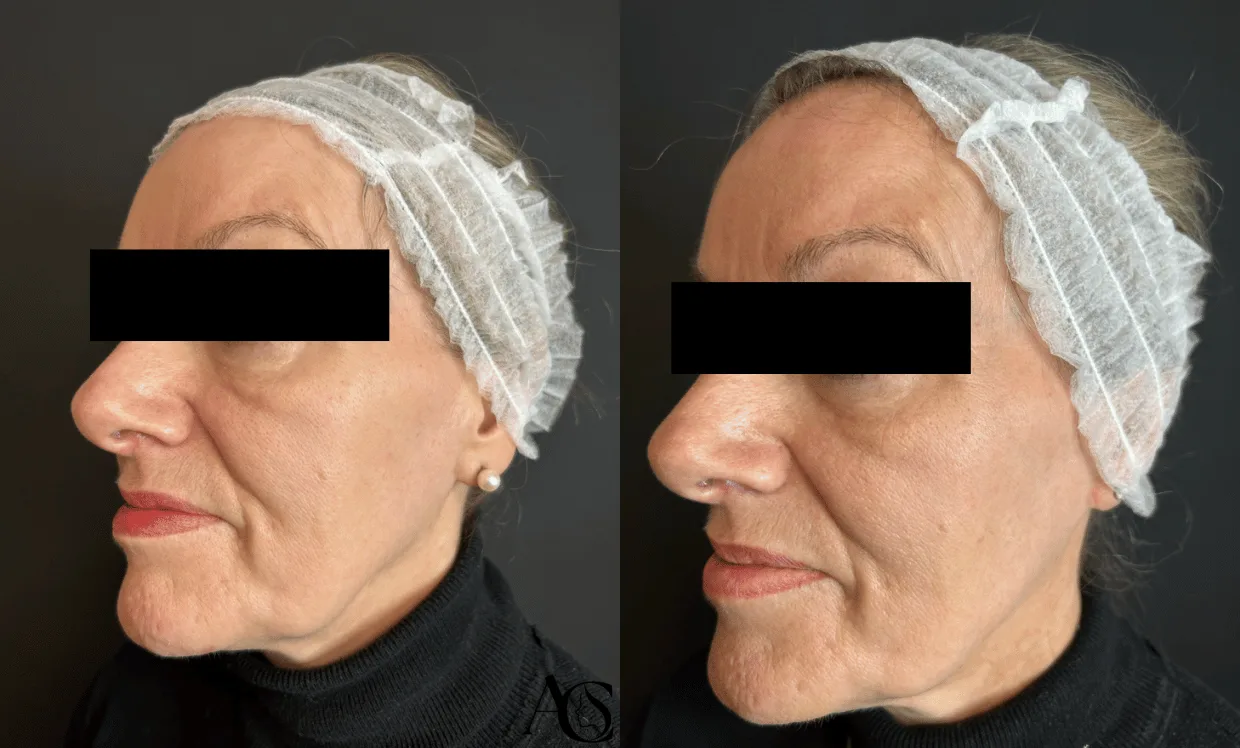
Results also vary meaningfully between patients. Facial anatomy, the degree of volume loss being addressed, and your body’s individual response all shape the outcome. Any before-and-after examples you come across during your research should be treated as general illustrations, not a preview of your own specific result. The clearest way to understand what HArmonyCa might do for your face is an in-person assessment, not a comparison photo.
How Long Results Last?
HArmonyCa’s longevity doesn’t follow one simple number, partly because of its dual mechanism.
The HA component is gradually metabolized by the body over time, similar to standard HA fillers. The tissue support from the CaHA component may continue contributing to your results even as the HA portion fades, though how long this lasts depends on your individual response, the area treated, and your overall skin condition.
There’s no fixed duration that applies universally. Some patients choose a follow-up treatment once they notice the effect softening. Others let results fade naturally and reassess later. Your provider can speak to general patterns based on your specific treatment, but an exact timeline isn’t something any clinic can promise in advance.
Side Effects and Risks Worth Knowing:
As with any injectable, HArmonyCa carries some risk of temporary effects. Swelling, redness, tenderness, and bruising at the injection sites are the most common.
Some patients notice small lumps or areas of firmness under the skin afterward. This isn’t automatically a problem. Minor irregularities can occur with injectable treatments generally, and many resolve on their own over time. Persistent lumps or anything that feels concerning should be reported to your treating clinician rather than left unaddressed.
More serious complications are less common but possible with any injectable procedure. This is part of why treatment should only be performed by an appropriately trained medical professional, and why your individual risk factors deserve a real conversation during consultation rather than a quick glance at a list online.
It’s also worth knowing that not every reaction shows up right away. Occasionally, effects can appear days or even weeks after treatment rather than immediately. If you notice anything unusual after you’ve left the clinic, whether that’s unexpected firmness, prolonged swelling, or a reaction that doesn’t seem to be improving, reach out to your treating clinician rather than waiting to see if it resolves on its own.
Recovery and What to Expect Afterward
Most patients return to their normal routine fairly quickly. Some mild swelling or tenderness in the days following treatment is typical.
General precautions after facial injectables often include avoiding strenuous exercise, extended sun exposure, and excessive touching of the treated area for a short period. Your specific aftercare guidance should come directly from Dr. Mayagoitia, since it’s based on your individual treatment rather than a one-size-fits-all routine.
Planning some flexibility into your schedule for a few days after treatment is a reasonable idea, especially if you’re weighing this around a specific event.
How HArmonyCa Compares to Other Treatments?
Patients often research HArmonyCa alongside other injectables they’ve heard about. Here’s how the mechanisms differ, without declaring a winner.
| Treatment | Immediate effect | Longer-term effect | Typical approach |
| HArmonyCa | Yes, from HA component | Yes, from CaHA component | Combined in one product |
| Sculptra | Minimal | Yes, gradual collagen building | Usually multiple sessions over months |
| Radiesse | Yes, from CaHA | Yes, from same CaHA component | Single-mechanism biostimulator |
| Traditional HA filler | Yes | No added collagen stimulation | Volume replacement only |
Sculptra relies almost entirely on gradual collagen building, with little immediate effect, and usually requires several sessions spaced weeks apart. Radiesse also uses calcium hydroxyapatite, making it the closest comparison to HArmonyCa’s mechanism, though it doesn’t include a separate HA component for immediate lift. Traditional HA fillers add volume directly without the added collagen-stimulating component that HArmonyCa and Radiesse both offer.
None of these is universally better. The right option depends on how quickly you want to see change, your specific treatment area, and your provider’s assessment of your anatomy. Still deciding between options? Discussing your priorities with Dr. Mayagoitia during a consultation is a more reliable way to choose than comparing product names online.
HArmonyCa Cost in Playa del Carmen
At AgeEssence Medical Center, HArmonyCa is priced at $16,500.
The right treatment plan, including the amount of product used, depends on your goals and your provider’s assessment. If you’re considering HArmonyCa in Playa del Carmen, contact AgeEssence Medical Center to arrange a free consultation and confirm what a treatment plan would look like for you.
Why Patients Choose AgeEssence Medical Center?
- Treatment is provided directly under Dr. Belinda Mayagoitia in Playa del Carmen.
- A free consultation is available before any treatment plan is finalized.
- Assessments are based on your individual anatomy and goals, not a fixed package.
- You receive honest information about what HArmonyCa can and cannot do for you.
- The clinic works with both local patients and visitors planning treatment around travel.
Considering HArmonyCa While Visiting Playa del Carmen
AgeEssence Medical Center welcomes both local patients and international visitors. If you’re planning treatment during a trip, reach out before you arrive to schedule a consultation and talk through timing.
Since some visible swelling is common in the days after treatment, it’s worth building buffer time into your travel schedule rather than planning HArmonyCa the day before an important event. Booking your consultation ahead of time also gives you space to ask questions before committing.
Take the Next Step
If you’re weighing whether HArmonyCa fits your goals, an in-person consultation is the most useful next step. Dr. Belinda Mayagoitia can assess your skin, talk through what you’re hoping to achieve, and give you a straightforward answer about whether HArmonyCa, or something else, makes more sense for you.
Request a Free Consultation. Call 984 138 5578.