
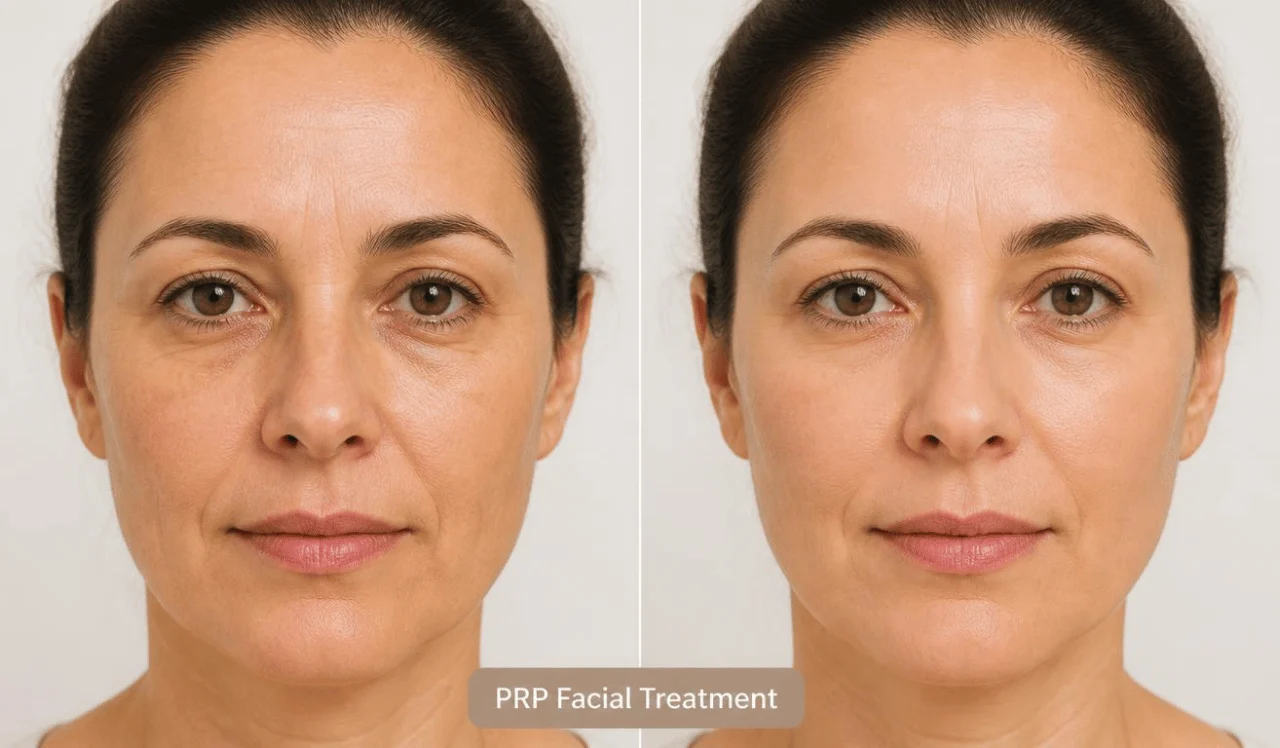

How Does Facial PRP Work?
The general concept behind Facial PRP is straightforward, even though the underlying biology is complex. A blood sample is drawn, much like a routine blood test. That sample is then processed to concentrate the platelets and separate them from red and white blood cells. The resulting plasma is applied to the face, typically through injection into targeted areas.
Once introduced to the skin, the concentrated platelets release growth factors that are thought to help stimulate collagen production and support the skin’s repair mechanisms over time. This is a gradual biological process, not an immediate cosmetic change, which is an important distinction for anyone comparing PRP to treatments with more instant visible effects.
Because the plasma used comes from your own blood, PRP is generally considered to carry a different risk profile than treatments using synthetic or donor-based materials. That said, it’s still a medical procedure, and suitability should always be confirmed through a consultation rather than assumed.
What Can Facial PRP Help With?
Facial PRP is most often discussed in connection with general skin quality concerns rather than a single specific condition. Depending on your skin and goals, a consultation with Dr. Mayagoitia may address whether PRP is a reasonable option for concerns such as:
- Overall skin texture and tone: Many patients consider PRP when they want to support smoother, more even-looking skin rather than address one isolated issue.
- Fine lines: PRP is sometimes used alongside a broader skin-quality plan rather than as a standalone treatment for deeper wrinkles.
- General skin quality and radiance: Because PRP works with the skin’s own repair processes, its role is generally supportive rather than corrective in the way a filler physically adds volume.
- Certain types of facial scarring: Some patients explore PRP as part of a broader discussion about improving the appearance of scarring, though suitability depends heavily on the type and depth of the scar.
- Under-eye area concerns: This is one of the more commonly discussed uses of facial PRP, though what PRP can realistically achieve in this area varies significantly from person to person and should be discussed directly with your provider.
Why Do Patients Consider PRP for the Face?
Patients typically bring up PRP for one of a few reasons. Some are looking for an approach that uses their own biological material rather than an injectable product. Others are already using treatments like Botox or fillers and are curious about a complementary option focused more on skin quality than on lines or volume. Some are specifically researching options for the under-eye area, where filler and other treatments carry their own considerations.
None of these reasons make PRP automatically the right choice. The honest answer to “should I get PRP” almost always depends on what your skin actually needs, which is something a consultation is designed to clarify rather than assume in advance.
What Happens During a Facial PRP Treatment?
A typical PRP visit follows a general sequence, though the specifics of your own treatment will be determined by Dr. Mayagoitia based on your skin and goals.
- Consultation. Before any treatment, you’ll discuss your skin concerns, medical history, and what you’re hoping to achieve. This is also the point where Dr. Mayagoitia can explain whether PRP is a reasonable fit for your goals, or whether another treatment or combination of treatments might serve you better.
- Assessment. Your skin is evaluated in person, since photos and self-assessment can’t substitute for a hands-on look at your specific skin type and concerns.
- Blood collection. A small blood sample is drawn, similar to a standard blood draw at any medical office.
- PRP preparation. The sample is processed to separate and concentrate the platelet-rich plasma from the rest of the blood components.
- Application. The prepared PRP is then applied to the treatment area, typically through injection into the target zones discussed during your consultation.
- Aftercare. You’ll be given guidance on how to care for your skin in the hours and days following treatment.
The exact technique, number of injection points, and any additional steps are determined by Dr. Mayagoitia based on your individual assessment, not by a fixed formula applied to every patient.
What Areas of the Face Can Be Treated?
Facial PRP is generally discussed in the context of areas where patients are most focused on skin quality and texture rather than the entire face indiscriminately. This commonly includes the under-eye area, cheeks, and other zones where fine lines or uneven texture are a concern.
Not every facial area is automatically suitable for PRP, and the right treatment areas for you will depend on your specific skin and goals. This is something to map out directly with Dr. Mayagoitia during your consultation rather than assume ahead of time.
It’s also common for a treatment plan to focus on one or two priority areas rather than the entire face at once, particularly for a first session. This allows both you and your provider to see how your skin responds before deciding whether to expand treatment to additional areas in future sessions.
Does Facial PRP Hurt?
Discomfort during PRP varies from person to person and depends on the treatment area and injection technique used. Some areas of the face are more sensitive than others, and a topical numbing option may be used to help manage discomfort, depending on your provider’s assessment.
Most patients describe the sensation as mild to moderate rather than severe, but pain tolerance is individual, and it’s reasonable to ask about numbing options during your consultation if you’re concerned about discomfort.
Is There Downtime After Facial PRP?
PRP is generally not associated with extensive downtime, but it isn’t a zero-effect procedure either. In the days following treatment, it’s common to experience some redness, mild swelling, tenderness, or bruising at the injection sites. These effects are usually temporary and tend to settle within a short period, though timelines vary depending on your skin and how your body responds.
Because visible redness or swelling is possible, it’s worth planning your treatment with some buffer time before any event or occasion where you want your skin to look its most settled, rather than scheduling it the day before.
Most patients are able to resume normal daily activities shortly after treatment, though your provider may recommend avoiding strenuous exercise, direct sun exposure, or certain skincare products for a short period afterward. Specific aftercare guidance will be tailored to your treatment and given to you directly following your session, since recommendations can vary depending on the areas treated.
When Will I See Results From Facial PRP?
Because PRP works by supporting your skin’s own biological repair process rather than producing an immediate mechanical change, results tend to build gradually rather than appear right away. Many patients don’t notice a dramatic shift immediately after treatment, and that’s expected given how the treatment works.
An exact results timeline varies from person to person based on skin type, the area treated, and individual healing response. Rather than promising a specific number of weeks, the more accurate guidance is that PRP results tend to develop over time, and Dr. Mayagoitia can give you a more individualized sense of what to expect once she’s assessed your skin.
How Long Do Facial PRP Results Last?
As with the results timeline, how long PRP effects last varies by individual. Factors like skin type, lifestyle, sun exposure, and overall skin health all play a role in how long any improvement is maintained. Some patients choose to repeat treatment periodically as part of an ongoing skin-quality plan, while others space treatments out differently based on their goals.
There’s no single verified duration that applies to every patient, which is why this is a topic worth discussing directly during your consultation rather than relying on a generic answer.
Who May Be a Candidate for Facial PRP?
Candidacy for Facial PRP depends on several individual factors, and it isn’t something to self-diagnose based on symptoms or concerns alone. A proper assessment requires an in-person consultation with Dr. Mayagoitia.
What determines candidacy:
- Your general health history
- Current skin concerns
- What you’re hoping the treatment will accomplish
- Certain health conditions and medications, which can affect whether PRP is appropriate
What happens during your consultation:
- Dr. Mayagoitia reviews your health history
- She examines your skin in person
- She discusses whether PRP, alone or alongside another treatment, makes sense for your specific situation
- If PRP isn’t the right fit, you’ll get that answer too, rather than being pushed into a treatment that doesn’t match your goals
Why being upfront matters:
- Sharing your full health background helps Dr. Mayagoitia give an accurate, individualized recommendation
- Skipping this step would mean a generic recommendation rather than one based on your actual situation
Facial PRP Compared With Other Treatments
Patients researching PRP often want to know how it compares to other facial treatments they’ve heard of. It helps to think of these as addressing different things rather than competing options where one is universally “better.”
- PRP vs Botox. Botox works by temporarily relaxing specific facial muscles to soften movement-related lines. PRP does not work on muscle activity at all — it’s focused on supporting the skin itself. Some patients use both as part of a broader plan, since they address different mechanisms.
- PRP vs Dermal Fillers. Fillers add volume using an injectable gel, which is useful for concerns like hollowing or lost structure. PRP does not add volume in the same way; its role is more about supporting skin quality and texture over time.
- PRP vs Microneedling. Microneedling and PRP are often discussed together because they can be combined, with PRP sometimes applied alongside microneedling to support the skin’s response to the micro-injuries created during that treatment. Used alone, each has a somewhat different mechanism and purpose.
- PRP vs other regenerative or skin-quality treatments. Various treatments aim to support overall skin health and appearance through different mechanisms. Which one — or which combination — makes sense for you depends on your specific skin and goals, which is best worked through with your provider directly.
None of these comparisons are meant to suggest PRP is superior or inferior to any of these options. The right choice depends entirely on what you’re trying to address. Get a free of cost consultation: +52 984 138 55 78
Facial PRP for Specific Concerns
PRP for Under-Eye Concerns:
The under-eye area is one of the more frequently discussed applications of facial PRP, in part because it’s a delicate area where many patients are cautious about more invasive options. Whether PRP is a reasonable approach for your under-eye concerns depends on the specific cause of those concerns, which can vary significantly between patients — something only an in-person assessment can determine.
PRP for Facial Scars:
Some patients explore PRP as part of a broader conversation about improving the appearance of certain types of facial scarring, often in combination with another treatment like microneedling. Not all scar types respond the same way, and an accurate expectation depends on evaluating your specific scarring in person.
PRP for Skin Texture:
General skin texture is one of the more common reasons patients consider PRP, particularly when looking for an approach that supports the skin’s own repair processes rather than one that adds volume or relaxes muscles. As with every use discussed on this page, individual results vary.
Facial PRP in Playa del Carmen for Local Patients and Visitors:
AgeEssence Medical Center serves both local patients in Playa del Carmen and visitors to the area, including those coming from elsewhere in Quintana Roo or further afield. If you’re planning to combine treatment with travel, it’s worth reaching out ahead of your trip to schedule a free consultation and talk through timing, since PRP involves some temporary redness or swelling that’s worth accounting for around your travel plans.
Booking your consultation before you arrive also gives you time to ask questions and understand whether PRP fits your goals, rather than making that decision for the first time on the day of your visit. Once your treatment plan is set, Dr. Mayagoitia’s team can walk you through what to expect and how to plan your visit around any recovery time.
This matters more for PRP than for some other treatments, since results build gradually rather than appearing immediately. Visitors on a short trip should factor this into their expectations — a single session during a brief stay is unlikely to show its full effect before you travel home, and that’s worth understanding going in rather than being a surprise afterward.
Why Choose AgeEssence Medical Center?
- Treatment is provided under the direction of Dr. Belinda Mayagoitia in Playa del Carmen.
- A free consultation is available before you commit to any treatment plan. Call 984 138 5578
- Assessments are based on your individual skin and goals, not a one-size-fits-all protocol.
- Treatment information is discussed clearly, including realistic expectations and limitations.
- The clinic serves both local patients and visitors planning treatment around travel to the region.
Ready to Discuss Facial PRP?
If you’re considering Facial PRP Treatment, the most useful next step is a conversation, not a decision made from research alone. Dr. Belinda Mayagoitia offers a free consultation to review your skin, answer your questions, and help you understand whether PRP is a reasonable fit for what you’re trying to achieve.
Request a Free Consultation: Call 984 138 5578